

 Get a Quote
A Custom Plastic Injection Molding Manufacturer for Parts Beyond the Prototype
A working prototype is a useful beginning. It does not yet tell a product team whether a molded housing will assemble consistently, whether a resin change will alter a sealing surface, or whether the next production quantity justifies a different tool. JY Pretech is a custom plastic injection molding manufacturer for teams navigating those decisions. Our work connects engineering review, in-house tooling, molded samples and production around the requirements of the actual part.
For an engineering buyer, the first useful questions concern the drawing revision, intended material, critical interfaces and quantities at each development stage. Start with our manufacturing capabilities and CAD-to-production process. These show the routes available before a project is committed to a production mold. A short run for assembly validation and a repeat order for released equipment need different evidence, even when their parts look identical.

What a custom plastic injection molding manufacturer should establish from your CAD
JY Pretech’s project process begins with your files and requirements. STEP or IGS models communicate three-dimensional geometry; a dimensioned 2D drawing identifies features that must be measured or treated differently. Include material, expected quantity, finish and the part’s function. Those inputs allow the manufacturing discussion to move beyond a general price for a general shape.
Housing interfaces deserve a different conversation from cosmetic covers
Consider a developer preparing an electronic enclosure for a pilot build. The outer cover may be mainly cosmetic, while the same molding contains a connector opening, mounting bosses and a joint with another housing. An attractive first sample can still fail the pilot if the connector is difficult to fit or screws distort the joint. The drawings should distinguish those interfaces from surfaces where a wider variation is acceptable.
Our portfolio includes device panels and assemblies, clear precision components, two-shot housings and overmolded handheld parts. These are different manufacturing problems. A translucent viewing area calls attention to surface condition and flow appearance; an overmolded grip adds an interface between materials; an inserted fastener adds a locating requirement inside the tool. Identifying the component family helps establish which questions must be answered before the steel is cut.

STEP and IGS files need an agreed drawing revision
The solid model should match the drawing used to approve the order. If a rib changes after a quotation, the team should review more than the revised feature itself: the modification may alter filling, ejection or a neighboring assembly surface. Keep the approved geometry, drawing revision and finish reference together. This gives sampling a defined target and prevents an earlier file from becoming the accidental production instruction.
For a part without a final drawing, separate development questions from released requirements. A team may be exploring a grip shape while the mounting arrangement is already fixed. That distinction can help JY Pretech review tooling flexibility. It does not remove the need to approve dimensions or guarantee that every later design change can be absorbed without a tool modification.
Custom plastic injection molding can start with rapid or bridge tooling
Not every product needs the same mold investment on its first order. Our rapid and prototype tooling service supports development work, material trials and shorter production programs. Bridge tooling can connect a product’s early demand to a more settled production plan. The purpose is to obtain useful molded parts while acknowledging the uncertainty that remains.
A buyer developing a fluid-handling accessory, for example, may need parts in the intended engineering resin before committing to the final cavity arrangement. Machined or printed development parts can answer some geometry questions. They do not necessarily demonstrate how a selected resin fills, shrinks and releases from a mold. The relevant question is which uncertainty the next build must remove.
P20 tooling and production tooling serve different development decisions
JY Pretech describes P20 among the tooling routes available for rapid projects. That is a starting point for discussing a development tool, rather than a universal instruction to select one steel for every resin and finish. An abrasive compound, a demanding surface or a longer program can change the appropriate mold construction. Tool life, expected quantities and the consequences of later geometry changes should be considered together.
Our published rapid-tooling process includes DFM review, tool design, CNC machining of cavity and core inserts, assembly, trial molding and sample inspection. Each stage has a different approval purpose. Tool drawings establish how the part will be made; molded samples establish what the process actually produces; inspection results help compare the outcome with the agreed requirements.
| Project position | Useful evidence from the next build | Manufacturing discussion |
|---|---|---|
| Geometry is still changing | Assembly fit and production-material behavior | Rapid tooling and change-sensitive features |
| A pilot order is approaching | Repeatable critical dimensions and acceptable finish | Bridge tooling, sample approval and release criteria |
| The product is released | Defined part acceptance and repeat-order requirements | Production mold configuration and documented revisions |
The resin choice changes more than the material name on the order
Our material portfolio covers engineering thermoplastics and high-performance polymers. ABS, PC, PA, POM, PP and PBT offer different starting points for familiar component families. PEEK, PPSU and PEI address more demanding operating conditions. Selecting the most expensive polymer is not a substitute for identifying heat exposure, chemical contact, load, appearance and the part’s mating materials.
A cover that needs toughness and a consistent decorated surface may have a different material discussion from a hot, loaded drive component. A fitting exposed to repeated cleaning adds another set of questions. Our high-heat material processing capability provides an additional route when the operating environment calls for it; it should not be treated as an automatic upgrade for a part whose requirements are already satisfied by a conventional engineering resin.
PEEK 450G and Ultem PEI should not be treated as interchangeable labels
The material directory includes named PEEK grades such as Victrex 450G alongside Ultem PEI and other engineering materials. Naming the polymer family is useful, but the exact grade remains important. Reinforcement, color and the intended service environment can affect which material and molding approach should be reviewed. The order should carry the approved designation rather than leave production to interpret a broad description such as “high-temperature plastic.”
General molding guidance from Victrex also distinguishes processing routes and material forms. That background can support an engineering discussion, but a supplier’s resin literature does not establish the performance of your finished part. A molded component still needs acceptance criteria and, where relevant, application testing tied to its geometry and use.
Overmolding and insert molding solve different component interfaces
A part that appears to need assembly may instead be a candidate for insert molding, overmolding or two-shot molding. JY Pretech offers those processes as part of its manufacturing range. The benefit is the ability to consider the interface while developing the molded geometry. The appropriate route depends on what the materials must do together and how the part will be produced.
For a handheld industrial control, a rigid substrate can establish mounting and dimensional features while a softer material provides the contact surface. For an enclosure that will be opened repeatedly, a metal insert may be relevant to the fastening arrangement. Neither feature makes a two-shot mold automatically necessary. The choice should account for substrate handling, material compatibility, tool configuration and the expected production program.
Avient’s overmolding guidance is a useful technical reference for material-pair considerations. It should inform the questions asked about a hard-soft combination, not replace evaluation of the exact grades and interface. Bonding assumptions are especially important where a soft material also participates in sealing or must resist peeling during use.
Our medical connector example shows why tooling and downstream work belong together
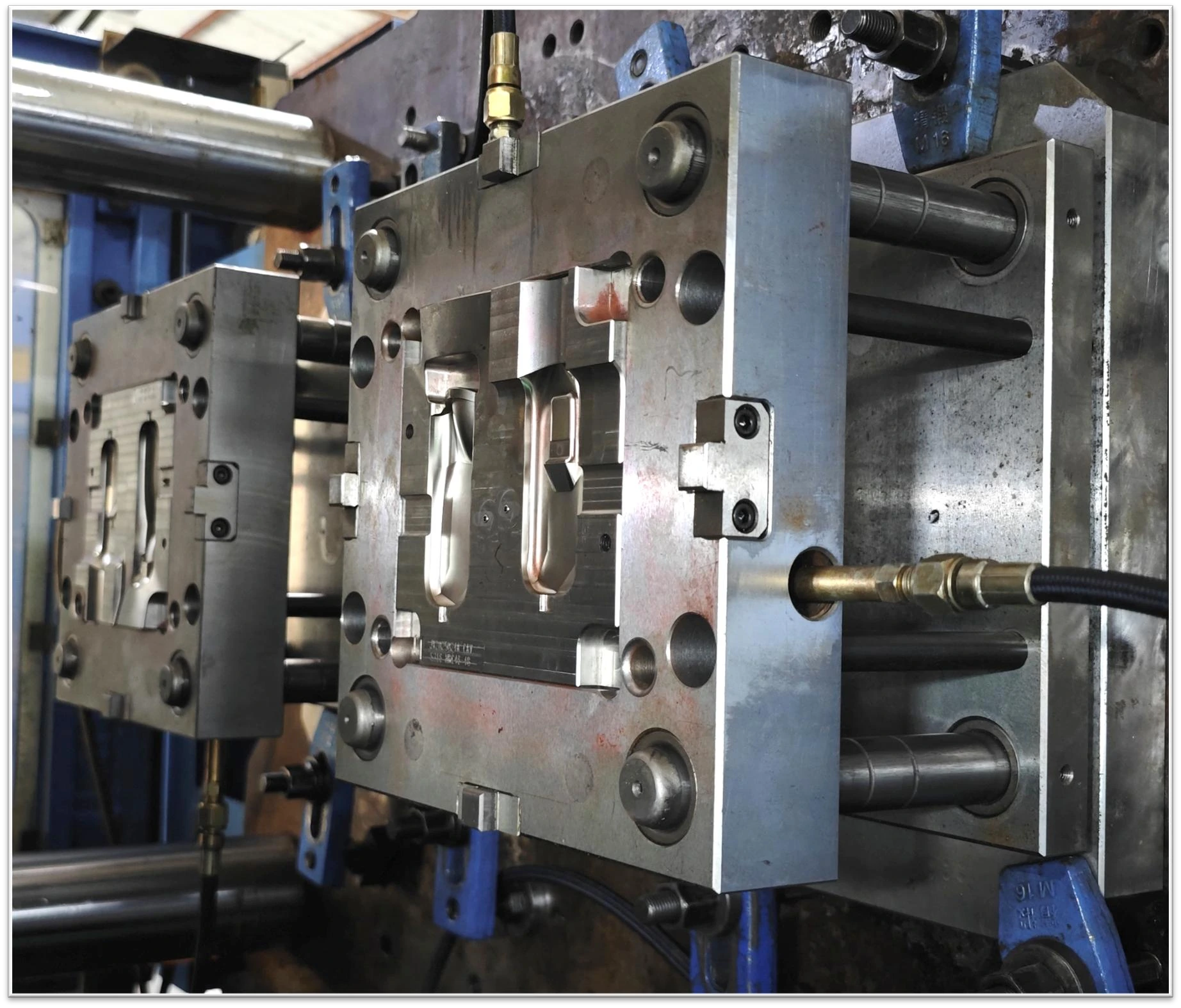
The published medical connector project provides a concrete example of JY Pretech’s manufacturing work. It records S136/S136 cavity and core material, PC specified as Lupilon S-3001R, a 1+1 family mold and an order of 1,000 parts. It also describes semi-transparent green color and pad printing using customer-supplied inks. Those details belong to that project; they are not default specifications for every order.
The connector case describes a DFM discussion covering gating, parting lines, mold structure, draft, ejection and wall thickness. It also makes an important boundary clear: the customer performs cleaning and sterilization after molding. That distinction matters for other engineering and medical buyers. A component manufacturer, a finishing operation and a device release process can have different responsibilities, and an order should identify them explicitly.
For a purchaser reviewing supplier suitability, this kind of specific manufacturing record is more useful than a general promise that every product is “high quality.” It gives the team a way to discuss comparable geometry, a particular material designation and the work required after the press. A new connector still requires its own technical review and acceptance plan.
A family mold also makes component identification part of the order
The connector’s 1+1 configuration makes a useful purchasing point: an order quantity must say whether it means complete sets or individual molded pieces. A buyer ordering a top and bottom housing can otherwise receive an unclear quotation comparison. State the number of each component needed for sampling, the number required for the pilot assembly, and whether replacement pieces are expected to be supplied separately. The tool arrangement should support that demand rather than conceal it.
The same example connects decoration with part identification. If pad printing carries an assembly reference or a mark that must remain legible after the customer’s subsequent process, the approved artwork and its location should accompany the drawing. Manufacturing approval should address that finished configuration, not a bare molding that omits a later operation. Agreeing these details early gives the buyer a useful sample to evaluate and gives production a more complete release target.
Molded housing inspection and delivery should protect the approved interfaces
Our engineering and inspection approach describes dimensional measurement and project-specific records. The company profile identifies 3D CMM and 2D projection equipment. The useful question is how a measurement method will establish conformity for your feature: a coordinate measurement may address a dimensional relationship, while a controlled visual reference can help define appearance. Available equipment alone does not decide acceptance.
When ordering an enclosure with a clear window, keep the relevant surface protected during the agreed handling and packing process. When ordering a component with thin projections or a soft overmold, discuss whether parts can touch each other without deformation or marking. These are part-specific packing decisions. They should be confirmed with the production quantity, handling method and destination requirements rather than inferred from a general shipping promise.
The same discipline applies to timing. JY Pretech presents rapid and low-volume manufacturing options, but the useful schedule for your order begins with the available files, required approvals and chosen process. Our explanation of mold development from design to production puts those dependencies in context. A design change, a material trial or an additional finishing step can affect the route. Identify them while the quotation and sampling plan are still being discussed.
Bring the next project discussion back to the prototype that started it. Decide which features are already settled, which assumptions the molded samples must test and what evidence will authorize the next quantity. JY Pretech’s value as a manufacturing partner is the ability to connect those decisions across tooling, material processing and finished-part preparation. A clear release path is a stronger foundation for a repeat order than an impressive sample with no agreed explanation of how it will be reproduced.