

 Get a Quote
Two Color Injection Molding Manufacturer: Keep the Color Boundary Functional
A contrasting band on a housing is easy to draw and harder to define for manufacture. Is the line a purely visual feature, the edge of a softer material or part of the enclosure’s mating geometry? A two color injection molding manufacturer needs that answer before the mold is designed. JY Pretech supports two-material and two-color components, including custom device housings. Begin with our two-color and 2K molding service and mark the boundary on a dimensioned model, not only on a rendered image.
For a purchasing team, the benefit is a clearer appearance agreement. For an engineer, it prevents the contrasting region from interfering with a button, connector or lid. The color split is a manufactured feature with geometry and material decisions behind it. Its appearance should be approved alongside the fit requirements that remain visible only after the housing is assembled.
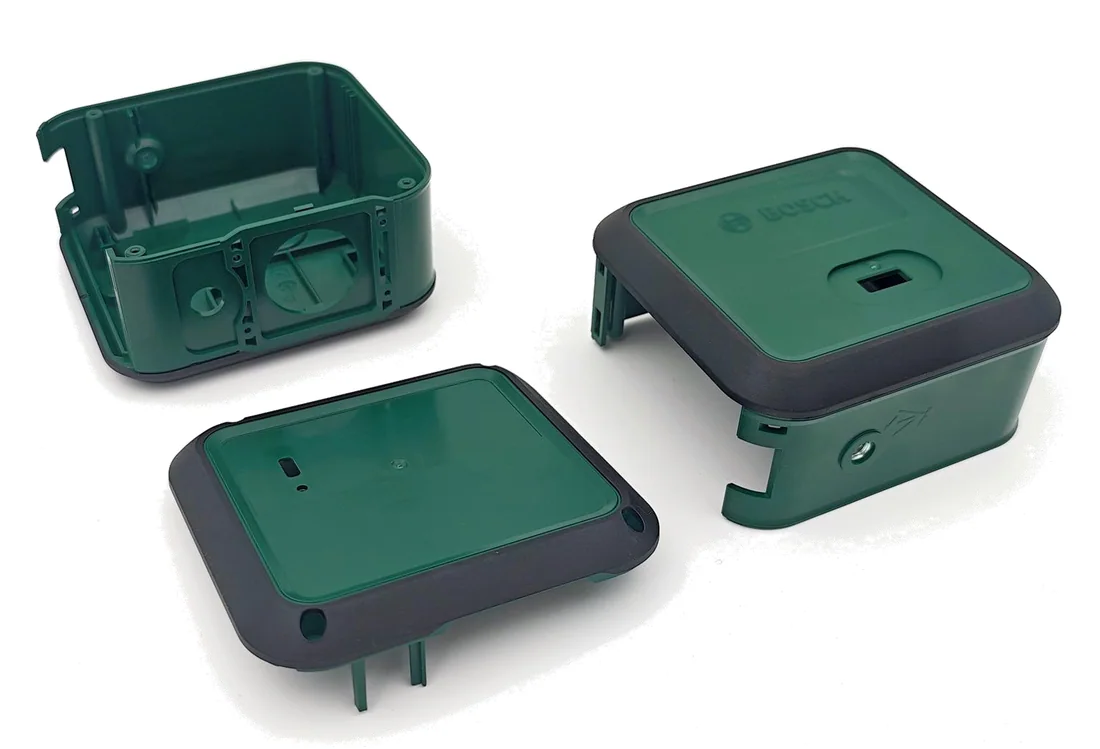
Define what the two-color housing line means on the drawing
Consider a hypothetical control enclosure with a dark grip band around a green rigid shell. The visual designer wants a continuous line, while the mechanical engineer needs a removable lid and unobstructed control openings. The molding drawing should identify where the band stops, how its edge relates to those features and which surfaces belong to each material. A color rendering alone cannot resolve those relationships.
A contrasting edge beside a button opening needs an actual clearance
If the second region reaches a moving control, identify the permitted material boundary relative to the opening. The toolmaker needs to know whether a visible edge is free to move within an appearance zone or whether it defines a functional clearance. This distinction determines how the sample will be assessed and prevents an attractive housing from being accepted before its control operates properly.
Provide the mating control geometry when its relationship is critical. JY Pretech’s DFM review covers gates, parting lines, wall thickness and draft. Those discussions can then consider the proposed boundary in the context of the assembled product. An apparently harmless change to the colored region may be unacceptable if it narrows a button opening or extends onto a locating surface.
A lid seam and a color seam should not be confused
A line between colors may sit near the physical split between enclosure halves, but the two lines serve different purposes. Identify them separately in the drawing. If the visual band is intended to appear continuous across two components, both parts need a coordinated reference. Approving each half independently can miss a mismatch that becomes obvious when the lid is installed.
For a second hypothetical project, imagine a small instrument with two separately molded side covers and a contrasting central detail. The buyer may value visual alignment more than perfect matching on a concealed face. Define that priority directly. Manufacturing and appearance decisions become easier when the critical viewing relationship is identified rather than left to the person unpacking the first samples.

A two color injection molding manufacturer should distinguish color from material function
Two visible colors do not necessarily mean that the second region must be softer. Conversely, a soft-touch region can be functional even if both materials have similar colors. JY Pretech’s offering covers compatible polymer combinations and hard-soft components. State whether the contrasting area provides touch, retention, sealing or appearance so the material proposal can be assessed against the correct purpose.
ABS with TPE 60A is a specific demonstration of a hard-soft route
Our homepage shows ABS combined with TPE 60A during a two-shot manufacturing sequence. That example can help a buyer understand the difference between a molded soft region and a printed color. It does not define the material of every housing in our portfolio. The exact grade and color formulation for a new component remain part of the project review.
Our two-shot material list also includes PA, PBT, PC and PP, alongside TPE-S, TPE-U, TPE-E, TPE-A and TPE-O families. The broad range is useful when comparing possibilities, while the approved order needs a narrower specification. Record the substrate grade, second material and color reference together. A color change should not silently become a material substitution.
Printing and laser marking suit details that do not require a second material
Legends, icons and small identifying marks may belong in a finishing operation rather than a two-color tool. JY Pretech lists pad printing, screen printing and laser etching among its secondary manufacturing operations. Compare those routes when the visual requirement is informational, especially if the graphic may change while the housing geometry remains common.
A molded color region remains relevant when the contrast follows a shaped surface or accompanies a material function. The decision should reflect the component’s purpose and approved appearance. Do not add a second molding stage only because a rendering uses two colors, and do not replace a functional flexible region with decoration simply because the resulting photograph looks similar.
Translate the housing appearance into a sample agreement
A color name is not a complete visual standard. “Black grip” or “green shell” can communicate an intention without defining the acceptable surface, viewing conditions or relationship to another component. The buyer should identify the reference samples and the areas that will be judged together. Our surface finish article explains why the molded finish belongs in the appearance discussion.
- Color reference
- Identify the agreed reference and which material region it governs. Do not rely on an uncalibrated screen image as the sole approval standard.
- Viewing relationship
- Show which housing faces are normally viewed together and whether adjacent components are supplied by another manufacturer.
- Boundary location
- Distinguish a visual preference from a feature that governs control clearance, assembly or sealing.
- Surface condition
- State the intended texture or finish and the appearance zones where molding witnesses require review.
For the instrument’s separately molded covers, retain the samples that establish their accepted appearance beside the central contrasting detail. Identify which cover and central-detail versions were viewed together. A later texture or color trial should not replace that matched reference automatically. Otherwise, purchasing can order three individually approved components without preserving the color relationship the designer actually accepted for the assembled instrument.
A textured soft region can look different from a smooth rigid face
Different surfaces can produce a different visual impression even when the color instruction sounds similar. Review the molded surface condition of both regions together. When a buyer approves only flat color references, the team should understand that the finished component geometry and texture still need evaluation. The point is to reduce ambiguity, not to promise a numerical color tolerance that has never been agreed.
General Avient overmolding design guidance treats texture as a contributor to the perceived surface feel. That is useful background for a hard-soft housing review. The customer should still assess the actual molded component and its intended use rather than regard a generic resin description as proof of the finished experience.
Make the two-color mold reflect the approved boundary
In JY Pretech’s described 2K route, the materials are injected on the same specialized machine before the completed component is ejected. Regular two-stage overmolding moves a first molded substrate into a second tool. Both approaches need a defined place for the second material to stop. The manufacturing concept should identify the relevant shutoff and the areas where excess material would affect appearance or fit.
For the control enclosure, ask how the first molded region is located during the second operation. If the visual line approaches the button opening, the proposed tooling must manage that relationship. A common shell shape does not automatically make every color-band variant interchangeable. Different boundary geometry can require a tooling change even when the exterior silhouette appears unchanged.
Our toolmaking services include 2K and overmolding tools. For a tool intended to run elsewhere, supply the receiving machine information and required mold standard before design approval. For parts manufactured by JY Pretech, agree the production route and quantity directly. These choices influence the commercial proposal and should be settled independently of the color palette.

Review color variants as controlled housing versions
A distributor or equipment manufacturer may want different colors to identify device versions. Establish whether the variants change only appearance or also signal a different material, application or assembly. The production order should associate the approved color reference with the correct component identity. This prevents a familiar shape from being accepted as the right version without checking the actual specification.
If the band carries a functional meaning, such as distinguishing a particular customer configuration, the assembly team needs a dependable way to identify the delivered version. Agree how packages and accompanying documents will distinguish the variants. JY Pretech’s project process allows packing and delivery requirements to be confirmed with the order; it does not make a single standard identification method appropriate for every customer.
For the green enclosure and dark band, identify the faces that will be viewed together at incoming appearance inspection. Agree how those faces will be protected from rubbing during the proposed shipment. If the separately molded covers are delivered as a matched appearance set, keep the central-detail reference identifiable with them. That allows the receiving approver to assess the same color relationship, rather than compare an undamaged cover with an unrelated version.
Approve the complete color relationship before releasing the housing order
A color revision should say whether the housing geometry remains unchanged
Suppose the purchasing team requests a lighter grip band after the mechanical sample has been accepted. State whether the change is limited to a proposed color formulation or whether the designer also wants a narrower band. Those are different revisions. The first needs material and appearance review; the second can affect the mold boundary and its relationship to the button opening. Combining both under a short instruction such as “update the blue version” invites confusion.
Keep the button-clearance sample identifiable while the lighter band is being evaluated. If the lighter trial also narrows the molded band, it no longer demonstrates only a color-formulation change. Recheck the revised edge beside the control opening before treating its appearance approval as permission to replace the mechanically accepted housing. If both band widths will remain available, identify their different geometry references as well as their colors.
For the enclosure assembled from separately molded covers, a replacement cover also needs a matching decision. The customer may accept a visible difference in a service part, or may require it to be assessed beside the existing assembly. That requirement should come from the product owner. A two-color manufacturer cannot infer a replacement appearance policy from a drawing that only defines the original complete housing.
The replacement-cover decision and the narrower-band decision should remain separate. One asks how a new cover should appear beside an existing enclosure; the other changes a molded boundary near a control. Keeping those questions distinct lets JY Pretech review a defined manufacturing change and lets the product owner approve the actual visual or mechanical consequence, instead of using one color label for two different revisions.
During sample review, assemble the housing with its intended controls, lid and adjacent components. Judge the visible alignment in that condition, then review any dimensional or functional findings separately. A color difference and a mislocated material edge may require different corrections. Treating every visual concern as a color formulation problem can send the tooling discussion in the wrong direction.
The stages described in our drawing-to-production workflow provide a practical sequence for resolving those findings before ongoing production. Record the accepted samples, drawing revision and finishing scope together. When the green shell, dark region and installed control all meet their intended relationship, the two-color design has become a defined manufactured component rather than a rendering that each participant interprets differently.