

 Get a Quote
ABS TPE Overmolding Supplier: Turn a 60A Sample Into a Defined Requirement
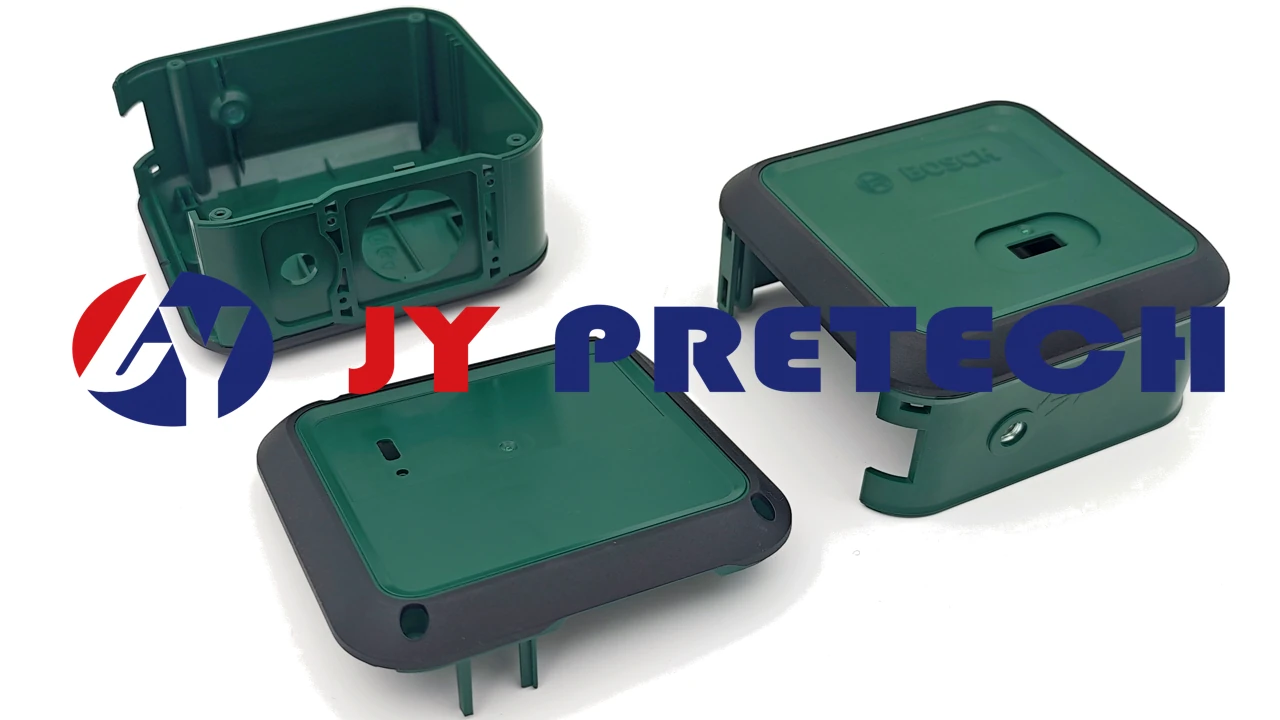
“Make it like this sample” leaves too much undecided for a hard-soft housing. A buyer may be pointing to the color, while an engineer is thinking about grip and the supplier is interpreting the material boundary. When selecting an ABS TPE overmolding supplier, identify which properties the reference actually establishes. JY Pretech’s published ABS plus TPE 60A demonstration offers a real construction to discuss through our two-shot molding service. It is a starting reference for a project-specific pairing, rather than a universal recipe for every ABS housing.
For the ABS/TPE housing, put the sample beside its shell drawing and mark the soft region it represents. Record whether the 60A reference settles hardness, touch, color or a boundary location. That gives engineering, purchasing and JY Pretech a defined construction to discuss instead of several different interpretations of the same sample.
Tell the ABS TPE overmolding supplier what the 60A reference is meant to prove
The published ABS/TPE example brings together a rigid polymer and a softer region. To use it as a meaningful reference, separate the hardness, substrate identity and intended function before asking the supplier to reproduce the effect on a new housing.
TPE 60A identifies a hardness target, not the complete compound
In this context, 60A refers to hardness on the Shore A scale. It does not identify the TPE family, grade, color system or bond behavior. JY Pretech’s two-shot material range includes TPE-S, TPE-U, TPE-E, TPE-A and TPE-O. A reference to TPE 60A should therefore be developed into a named material proposal appropriate to the ABS grade and the component’s use.
Imagine an instrument manufacturer approving a hand-held enclosure because the soft region feels comfortable. If the recorded approval says only “60A, black,” the team has not established the exact compound or the way it must be retained. A later sample could satisfy that short description while feeling different on the actual wall thickness. Preserve the physical reference, but write down the decision it supports.
The ABS substrate needs its own material identity
Our materials range includes ABS and other engineering thermoplastics. A material family on that list does not authorize a substitution within an approved project. Identify the ABS grade, color and any specific documentation requirement, including whether the customer nominates the source. If a candidate changes, review the material pair together rather than approving each resin in isolation.
Avient’s overmolding processing guidance identifies substrate condition, color systems, moisture and processing among the factors that can influence adhesion. These are general technical considerations, not evidence that a particular pair will bond on your component. They explain why the approved reference must be linked to an identifiable construction.
A soft region on a housing can serve more than one function
Mark whether the TPE is intended for grip, impact contact, a visual distinction or a sealing feature. A housing may combine these intentions, but each needs an appropriate acceptance basis. A successful color review cannot establish sealing, and a comfortable grip does not establish retention when the product is pulled from a cable or bracket.
For example, a distributor introducing two variants of a handheld device may want the same ABS shell with different TPE colors. That is a useful commercial arrangement only after the team decides whether the color variants share the same approved compound basis and functional requirement. A color change should not silently become a material change.
Convert the hard-soft sample into a drawing the toolmaker can use
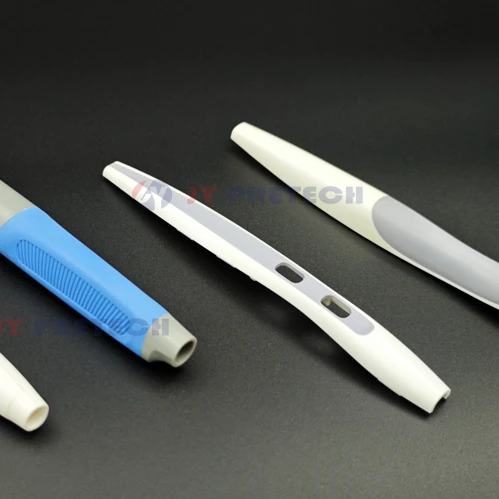
The model describes the finished shape, while the drawing and supporting references should explain what cannot change. JY Pretech requests STEP or IGS geometry together with dimensioned 2D information, material, finish and critical tolerances. For ABS and TPE, add the boundary between materials and show the assembly features that must remain accessible after overmolding.
| Reference carried with the ABS/TPE sample | Decision to record | Why the housing team needs it |
|---|---|---|
| Rigid shell drawing | ABS grade, revision and mounting datums | Locates the soft region without losing the assembly reference |
| Soft region model | TPE extent, exposed edges and local thickness | Describes the actual contact construction being evaluated |
| Appearance reference | Accepted color, texture and viewing side | Separates cosmetic approval from a functional trial |
| Interface requirement | Retention purpose and agreed evaluation | Prevents an attractive sample being treated as proof of every load condition |
| Supplied condition | Trimming, marking, assembly and delivery protection | Defines the component that arrives at the buyer’s next operation |
The ABS/TPE shutoff should follow the intended material boundary
A shutoff is part of the tool arrangement that limits where material can flow. The visible transition on a housing needs to be considered alongside the rigid wall that supports it. Identify whether a boundary is a cosmetic line, a finger contact edge or an area next to a control opening. Those locations should not inherit the same acceptance simply because they share the same color transition.
JY Pretech’s two-shot design guidance discusses sectional overmolding and mechanical retention features such as keyways or undercuts. If the design uses those features, include their purpose in the review. A feature that improves retention may require a local geometry change, and that change must remain compatible with mounting space, neighboring ribs and the intended surface.
Keep gate and trim locations away from the user’s critical contact
The sample handoff should identify where a gate vestige, parting-line witness or agreed trimming operation is acceptable. On a handheld product, a small raised feature can matter more under a finger than on an internal face. JY Pretech reviews gates and parting lines during DFM, so show these contact zones before the tooling is released.
Do not specify that every surface must be perfect without defining what that means. Provide an appearance reference and distinguish exposed grip zones from hidden assembly regions. If trimming is part of the accepted production scope, its result should be represented in the sample the customer approves rather than left as an undocumented finishing assumption.
Approve ABS TPE overmolding samples through separate engineering decisions
One signature can conceal several unfinished decisions. A more useful release identifies what is approved now and what still requires evaluation. JY Pretech’s project process connects DFM approval, tool construction, trials and inspection. For a hard-soft enclosure, use those stages to settle the rigid dimensions and the soft interface with the people responsible for each.
- Confirm the rigid housing: review mounting points, fastener access, openings and mating faces against the released drawing.
- Evaluate the molded soft region: check the intended texture, boundary and contact experience on the representative construction.
- Resolve the interface: apply the agreed retention or application evaluation to the identified material pair.
- Approve the delivered component: include any specified trimming, decoration, assembly and identification in the accepted sample condition.
This sequence is especially useful when an engineering team evaluates function while purchasing evaluates appearance and delivery. Record which sample each group examined. Otherwise, a printed enclosure, an unprinted assembly trial and a color plaque may all be described as the approved sample, even though they answer different questions.

Compare the finished hard-soft housing after its secondary operations
Our capability portfolio includes pad and screen printing, laser etching, coating, insert installation, ultrasonic welding and assembly. Select the operations the actual housing needs, then review their sequence. A marking must remain legible in its intended location, and an assembly operation must not unintentionally compress or damage the grip edge.
A customer transferring printed artwork between device variants should identify which rigid features locate that artwork. The TPE boundary may provide a visual reference, but the engineering reference could be a mounting hole or connector opening. Keeping those roles separate reduces ambiguity when the artwork, the shell and the overmold are revised at different times.
Our article about surface finish communication in molding can help the team describe a desired surface. For the actual ABS/TPE release, retain the agreed material-specific appearance reference. A finish designation cannot replace a representative sample where touch and a visible material transition control acceptance.
An ABS/TPE sample change should state which design decision it reopens
A revised sample can arrive with a sharper color boundary and still leave its meaning unclear. Ask what changed between the versions: the rigid geometry, the compound, the surface texture, the molding arrangement or a finishing operation. The sample identifier should lead back to that change. It is then possible to decide whether the buyer needs another appearance review, an assembly check or a new interface evaluation.
A color-matched TPE sample should not replace the functional reference silently
A handheld product team may approve a natural or trial-colored component for handling before the final appearance is available. When the final color is introduced, preserve the earlier functional decision and identify what must be rechecked. The final colored construction should not inherit every acceptance automatically, nor should the original engineering reference disappear merely because it no longer represents the intended appearance.
Likewise, a sample produced to explore the visible boundary should not be sent to the assembly team as the released housing unless that status is explicit. The ABS mounting features and the TPE contact region may be at different development stages. Describe the permitted use of each sample so the device team does not build an apparently valid pilot assembly from an appearance-only trial.
ABS housing revisions should remain visible beneath the overmold
An internal rib or mounting boss can change while the outside remains identical. If a revision affects the region beneath the TPE, show that change in the model comparison and drawing record. The team should review whether the overmold support or tooling arrangement is affected, rather than treating the change as hidden and therefore irrelevant to the hard-soft process.
This is also useful when the same enclosure shell supports several device variants. Keep a component matrix that distinguishes the ABS revision, accepted TPE construction and decoration for each version. The matrix is a project control for that housing family, not a replacement for the individual drawings. It lets purchasing order the intended combination without asking the supplier to infer it from a previous shipment or a photograph.
Make the ABS/TPE release readable at the assembly bench
The finished order should tell the receiving team which version to use without asking them to infer it from color. This matters when prototype and production housings look similar or when two TPE candidates were tested in the same shell. Agree how the part number, revision and approved variant are communicated on the delivery documents and any requested labeling.
A long soft edge needs a different protection discussion from a flat rigid panel. Describe where pressure, rubbing or bending would affect the accepted condition. Ask the team to agree protection for those features and the intended route to assembly. Do not assume a particular bag, tray or separator is included unless the quotation or order defines it.
The quantity also belongs to the selected route. Our website describes both separate-stage overmolding and integrated 2K production, with different commercial considerations. Selected molding services can support low-volume work, while a 2K program has its own tooling and batch review. Confirm the route and quantity basis for this ABS/TPE construction instead of transferring a general no-minimum statement to every production method.
When an approved sample changes, identify whether the change affects the ABS shell, the TPE compound, the color, the boundary or a later operation. A new grip color can be easy to see, while a revised substrate grade can be visually invisible. Both deserve an explicit disposition before the next release is treated as identical to the first.
Before authorizing tooling, put the reference sample beside the proposed drawing and quotation. The material identities, 60A target, soft-region extent and accepted supplied condition should tell the same story. JY Pretech can then review a defined hard-soft housing, and the buyer can approve a construction that the next team will recognize for the right reasons.