

 Get a Quote
What an LSR Injection Molding Supplier Needs From the Device Team
The first purchasing delay often happens before a tool is ordered: engineering specifies a silicone shape, quality asks for a material document and purchasing requests a delivery date, but the three requests describe different supplied conditions. An LSR injection molding supplier needs one connected definition. For medical-device components, electronics interfaces and other flexible details, JY Pretech reviews the geometry, material, tooling and agreed inspection scope through its liquid silicone molding service. Send the mating geometry and documentation requirement alongside the silicone drawing so the first proposal can address the component you intend to accept.
Give the LSR injection molding supplier one release package across departments
JY Pretech’s project workflow requests 3D geometry in STEP or IGS, dimensioned 2D drawings, the material, quantity, finish, critical tolerances and target timing. An LSR component benefits from an additional explanation of its installed condition. Identify whether it is a separate flexible part, a silicone region combined with another material or a component supplied after assembly.
The silicone drawing should identify both free and installed requirements
For a flexible enclosure interface, mark which dimensions describe the unloaded part and which requirements apply after installation. Provide the relevant rigid surfaces and the closure arrangement. The supplier should not have to guess whether a drawing dimension is intended to control a free perimeter, a compressed region or an assembled gap.
Imagine an electronics buyer replacing a soft interface while retaining an existing housing. Engineering should provide that housing’s interface rather than sending only a returned silicone part. A worn component can help describe the problem, but it may no longer represent the released shape or material. Its role in the review should be stated explicitly.
Tie LSR material documents to the component being approved
A material data sheet, a material lot document and a finished-part inspection report answer different questions. Say which document is required, what it should identify and when it is needed. The requested evidence should refer to the actual proposed material and component, rather than to silicone as a broad family.
For a healthcare project, the intended contact and customer validation plan may affect the required material evidence. Provide those requirements at the start. JY Pretech can review the requested supply scope, while the device manufacturer determines what evidence is necessary for its own product and intended use.
Reconcile the LSR grade name before the first tooling release
Our published materials include WACKER ELASTOSIL LR 3003, SILASTIC references such as LSR 591, 9001-50 and 94-595, and Shin-Etsu KE G2000. These are useful starting references for discussion with the project team. A production instruction must still identify the full proposed grade, color and any source restriction, with current availability confirmed for the order.
The JY Pretech material list should be read as capability information. It does not demonstrate that every listed material is on hand, interchangeable or supported by the same declarations. If the buyer requires a nominated compound, keep that requirement visible in the quotation and the sample approval.
Raw silicone declarations do not define a finished medical component
DuPont’s medical LSR information distinguishes material products and their intended-use considerations. Its documentation illustrates why a declaration must be read for the particular compound and use. It does not qualify a JY Pretech component or replace the device team’s validation.
A medical purchasing team should define the delivered condition separately from the raw material. If cleaning, post-cure, special handling or sterilization forms part of the intended workflow, allocate responsibility and acceptance in writing. A medical application should never cause the receiving team to assume that ordinary molded parts arrive sterile.
A material alternative should carry its own acceptance decision
If a compound is unavailable, ask the technical team to compare a clearly identified candidate against the original requirements. Similar hardness, appearance or family naming does not establish equivalence. The revised proposal should state what changes and which evidence or trials need review before the alternative can be accepted.
This distinction is useful for an industrial buyer whose original material was nominated years earlier. The supplier can help review a current option, but a procurement substitution should not silently alter the component definition. Keep the customer’s technical decision attached to the new material instruction so the trial and next order use the same basis.
Match supplier capability evidence to the proposed LSR component
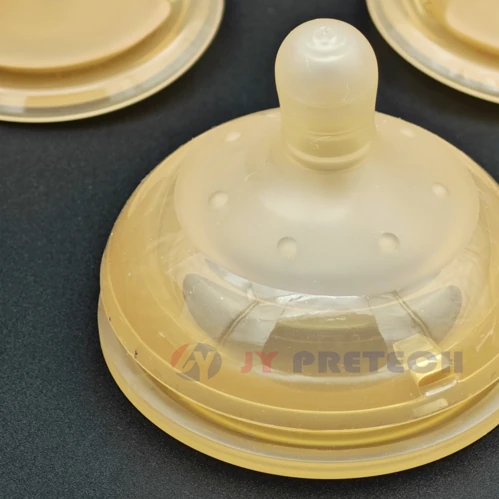
JY Pretech’s capabilities cover custom liquid silicone components and overmolding, alongside thermoplastic injection molding, tooling and assembly support. The relevant qualification question is how that combination addresses the actual component. For a silicone interface with a PC counterpart, review both drawings and the proposed division of manufacturing work.
LSR machine tonnage is a screening detail, not a complete feasibility result
Our August 2025 company profile lists an LSR machine range of 120–260 tonnes. That dated profile is useful background for a supplier discussion. It is not a reservation of current capacity or proof that a particular part and mold suit a particular machine. Geometry, tooling concept, material and project requirements still need review.
Ask how the proposed tool, molded geometry and agreed sample program fit the production plan. If a quotation depends on a particular manufacturing route, the scope should make that clear. A machine range by itself cannot establish the inspection method, surface acceptance or schedule for the buyer’s device component.
LSR workshop evidence should be compared with the handling requirement
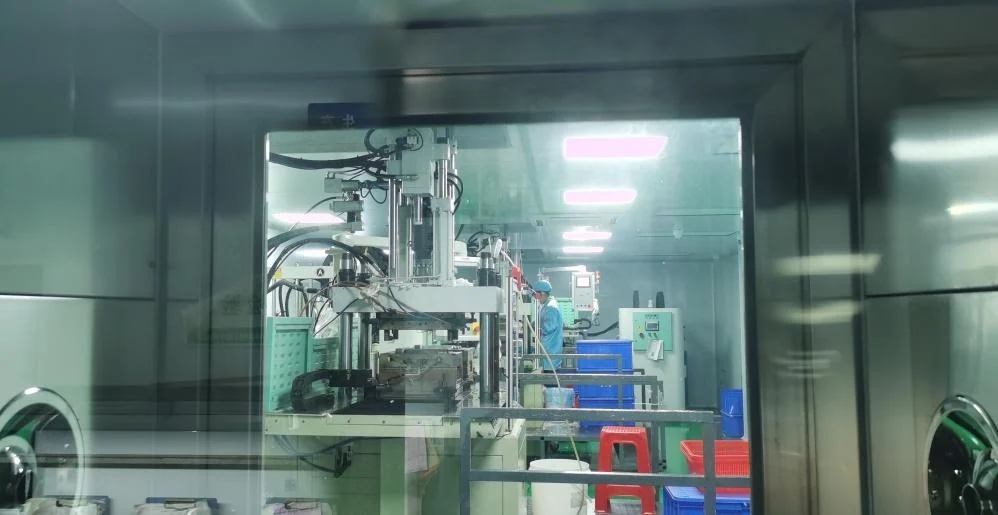
Our site shows an LSR production environment and identifies ISO 9001:2015 quality management. A buyer requiring certification should request the current certificate and applicable scope. Photographs and a quality-system statement provide company context, but a controlled area must not be interpreted as proof of a specified cleanroom class or a medical-device certification.
Translate any special requirement into the supplier review. Identify the component surfaces concerned, the handling or cleanliness acceptance and the documents the customer needs. That gives JY Pretech a concrete requirement to assess, rather than relying on two teams to attach different meanings to a word such as medical or clean.
Separate the LSR trial’s engineering evidence from the purchase release
JY Pretech’s manufacturing process connects quotation review, DFM, tooling, trial parts and production approval. For a silicone component, the DFM should identify the functional surfaces and the conditions under which their geometry matters. The agreed trial should then address the uncertainties that remain after that review.
A sample may establish that the part can be molded and demolded in the proposed form. A different review may establish dimensional acceptance. The customer’s assembly assessment may still be needed to determine whether the component works in the device. Record these as separate findings so a tooling milestone is not mistaken for the final application release.
| LSR project record | Evidence it should preserve | Person or team that needs to interpret it |
|---|---|---|
| Material proposal | Exact compound and agreed supporting documents | Customer material or quality reviewer |
| DFM disposition | Accepted geometry, interface and tooling decisions | Design team and toolmaking team |
| Trial inspection | Identified sample version and agreed measured features | Supplier inspection team and customer engineering |
| Assembly assessment | Relevant mating parts and customer acceptance result | Device team responsible for application performance |
| Production release | Approved component, supplied condition and order quantity | Purchasing and receiving teams |
For background on how those stages relate, our article on mold development from design through production describes the connection between the tool and the sample. In an LSR project, the same discipline helps keep geometry correction, compound selection and application approval from being confused.
Include the rigid counterpart when the supplier provides a silicone assembly
JY Pretech’s portfolio contains PC-plus-LSR mask assemblies and separate flexible silicone examples. For a new project using that general architecture, identify who supplies each component and where the final relationship is created. A drawing of the soft region alone may omit the feature that locates it or limits its movement.
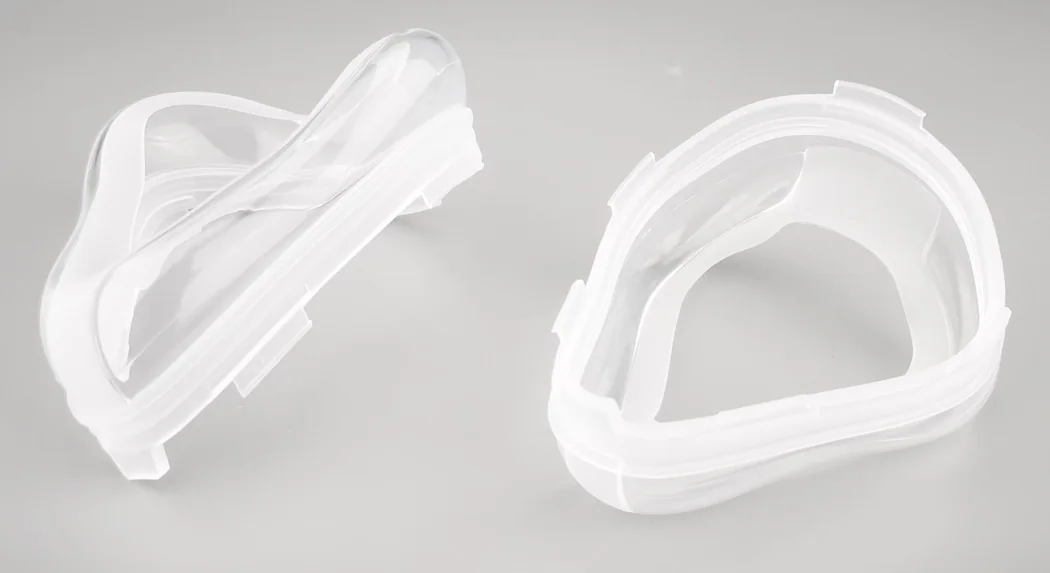
If the customer provides the rigid part, give its revision, material and incoming acceptance with the supplier brief. If JY Pretech is asked to mold both parts, include the thermoplastic requirements and any secondary operations in the same scope review. Our connected capability range includes injection molding, overmolding, insert installation and assembly, but the chosen combination is confirmed for the project.
A device program may also compare LSR with a TPE overmold or a separately produced silicone component. Those proposals can differ in material behavior, tooling and assembly. Ask each proposal to describe the supplied object and the outstanding validation work. Comparing one finished assembly with another supplier’s unassembled molded part produces an incomplete commercial comparison.
The first LSR delivery should preserve the distinction between trial and production
A device team may request extra silicone pieces while the tool is still being adjusted. State whether those pieces are for assembly development, material evaluation or an approved production build. The order quantity alone does not explain their status. If the customer needs a report with the samples, its identified revision and inspection scope should match the pieces actually shipped.
Trial silicone quantities should be allocated to the intended evaluation
For a flexible mask component, engineering may need parts for mating-fit evaluation while another team needs retained appearance references. Plan those uses before the sample shipment is divided. A reference that has been stretched, trimmed by the customer or assembled repeatedly may no longer serve the same purpose as an untouched appearance sample. The allocation should support the decisions each team must make.
An electronics program can have a different split: one set for closure assessment and another for agreed dimensional review. If the supplier and customer inspect different sample versions or differently handled pieces, the reports can appear inconsistent even when they describe different objects. Identify the sample and its relevant condition before comparing the findings.
An LSR purchase release should identify who closes each open decision
Before repeat production, check whether the remaining question belongs to the molding supplier or to the device team. A gate-location correction is different from a customer’s unresolved assembly acceptance. Assigning the question to the appropriate decision maker helps avoid production being authorized while everyone assumes that someone else has completed the application review.
This is a practical way to assess supplier communication: the project record should make the next decision understandable. JY Pretech’s coordinated tooling, molding and inspection workflow is most useful when the customer provides equally clear approval responsibilities. The release can then identify the accepted silicone component and the work included in its supply.
Agree what the receiving team will identify in an LSR shipment
Decide how the silicone part number, drawing revision and approved material are associated with the shipment. If several sample variants have circulated, make the released version distinguishable from development pieces. Where the order requires lot information or inspection documents, define the required connection between that evidence and the delivered component.
For a mask-shaped part, packing should account for the perimeter rather than simply the overall box dimensions. For a small seal or flexible detail, the buyer may need a different method of counting and protecting parts. Explain the next handling step and agree an arrangement that preserves the accepted shape and surface. Special packaging is a project requirement to confirm, not an implied property of LSR supply.
Bring schedule questions back to the unresolved decisions. A tool review, nominated compound, trial iteration or customer assembly approval may each affect when production can be released. The accepted quotation and project schedule should govern the commitment, with delivery arrangements discussed for the actual destination and supplied condition.
The most useful supplier package is the one your own teams can all read without adding assumptions. Give JY Pretech one silicone definition, one material decision and a clear allocation of inspection and application acceptance. Purchasing can then release an identified component whose supporting records make sense at the receiving bench.