

 Get a Quote
TPE Overmolding Manufacturer Choices Behind a Durable Soft-Touch Grip
A grip can feel convincing on a sample table and become frustrating on the equipment it was designed for. The surface may slide under a glove, catch at its edge or soften the outline of a control. For industrial product teams, a TPE overmolding manufacturer should help define those contact conditions before choosing the compound and tooling route. Start with JY Pretech’s two-shot and hard-soft molding service, then identify the rigid material, grip area, exposure and required retention. A hardness value alone cannot describe the finished handle.
A TPE overmolding manufacturer should begin with the user’s contact conditions
Consider an equipment maker developing a handheld controller. A bare-handed demonstration may favor a smooth, compliant surface, while the real operator uses gloves and presses sideways against the handle. That project needs the contact surface reviewed in the intended handling condition. It also needs the housing’s fasteners, openings and assembly datums protected from changes made to improve the grip.
A second buyer may be redesigning a frequently cleaned device. Here, the question is whether the nominated compound, texture and edge geometry remain suitable after the customer’s cleaning routine. The cleaning agent, concentration and exposure belong in the brief. Neither scenario represents a promised test result; each shows why JY Pretech reviews material pairing and part interfaces before manufacture.
Grip texture and elastomer hardness answer different questions
Hardness describes resistance to indentation under a defined test. Texture describes the contact geometry. Two surfaces with a similar hardness can feel and behave differently because of their texture, thickness and support. On a thin overmold supported by a rigid wall, the user’s impression also includes the substrate beneath it. Approve the intended molded construction rather than transferring a judgment from a loose material plaque.
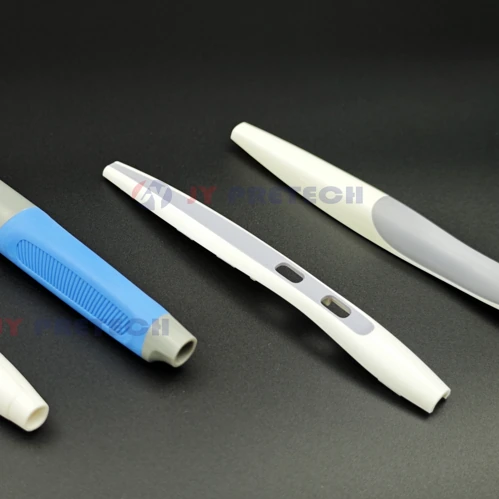
JY Pretech’s portfolio includes overmolded handheld components and hard-soft device housings. Those examples are useful starting points for discussing contact areas, material boundaries and assembly requirements. They are custom manufacturing examples, so a similar outline does not establish that the same compound or construction fits your application.
Separate TPE-S, TPE-U and TPE-E before comparing grip samples
Our published two-shot service lists styrene block copolymers, designated TPE-S; thermoplastic polyurethane block copolymers, TPE-U; and copolyesters, TPE-E. It also lists copolyamides, TPE-A, and olefinic thermoplastic rubbers, TPE-O. This range provides several material families to investigate. The family name is the beginning of selection, rather than a complete specification for bonding, appearance or environmental performance.
A TPE-S grip still needs a substrate-specific grade decision
A purchase instruction that says only TPE-S leaves important information unresolved. The exact compound must suit the intended rigid polymer and the application. JY Pretech lists PC, PA, PBT and PP among its two-shot substrate materials; its published examples also include ABS with TPE. These are separate pairing discussions. A successful combination with ABS should not be assumed to establish adhesion to a different PC, PA or PP grade.
For general engineering background, Avient’s overmolding material guidance distinguishes solutions by substrate. That supports a practical approach: nominate both materials and obtain the relevant compound recommendation before freezing the interface. It does not identify an Avient compound as our standard stock or establish the result of a JY Pretech trial.
TPE-U and TPE-E proposals should be tied to the grip’s duty
If an engineer proposes a different elastomer family to address abrasion, flexing or exposure, explain the duty that motivates the change. Ask for the chosen grade’s evidence against that requirement. A family-level reputation does not resolve the behavior of a thin edge, a textured surface or a molded joint on your particular component. The relevant comparison is between defined candidate constructions.
Keep those candidates separate in the sample program. A compound change should retain its own identity even if the color and nominal hardness remain similar. Otherwise, a user evaluation may be attributed to the wrong material and the purchasing team may reorder a sample that engineering never actually approved.
Overmold edges deserve as much attention as the soft contact area
The edge is where an operator can catch, rub or peel the soft region. It is also where the mold must stop the second material from entering an unwanted area. A wide grip patch with a poorly supported termination can therefore be a less useful design than a smaller, well-defined contact region. Our two-shot design guidance recommends applying the overmold in sections and reviewing its relationship with the supporting substrate.
Keyways and undercuts can contribute to TPE retention
JY Pretech’s design guidance identifies undercuts, keyways and other mechanical features as options when greater holding power is needed. Discuss them where the hand load could lift the material from the rigid core. Their purpose and location should be visible in the design review, because a feature added for retention can also affect wall geometry, tooling movement and the appearance of the opposite surface.
Mechanical retention and material adhesion should be described separately. A retained overmold is not automatically a sealed interface, and a promising bonded sample does not eliminate the need to consider edge loading. If the soft region also serves as a seal, add the mating geometry and leakage acceptance to the project. A grip evaluation cannot qualify that additional function.
Recessed TPE boundaries can protect adjacent housing features
Our published guidance also discusses locating the overmold slightly below the substrate surface. Whether that detail suits a new part depends on the intended contact and assembly. On a controller, a boundary near a fastening point needs to leave access for the assembly operation. Beside a button opening, the soft material must not interfere with travel or obscure the intended clearance.
Mark these regions before the tooling concept is approved. A cosmetic line on a rendering can become a functional boundary in the mold. JY Pretech’s drawing, DFM and sampling process provides the sequence for reviewing wall thickness, draft, gates and parting lines while the geometry can still be discussed.
Choose two-shot production or a separate overmolding stage for the actual handle
JY Pretech distinguishes 2K molding, in which both materials are processed on a specialized machine before a single product ejection, from a separate-stage overmolding route involving transfer of the first component to another mold. The distinction affects tool construction, handling and the manufacturing proposal. It should follow the component and expected order pattern.
For a handle whose shape is still being evaluated, the ability to review changes may matter more than an assumed high-volume advantage. For a settled hard-soft housing with repeat demand, the integrated production route may deserve closer examination. Our manufacturing portfolio includes rapid and bridge tooling, conventional injection molding, overmolding and two-shot molding, allowing the discussion to begin with the development stage.
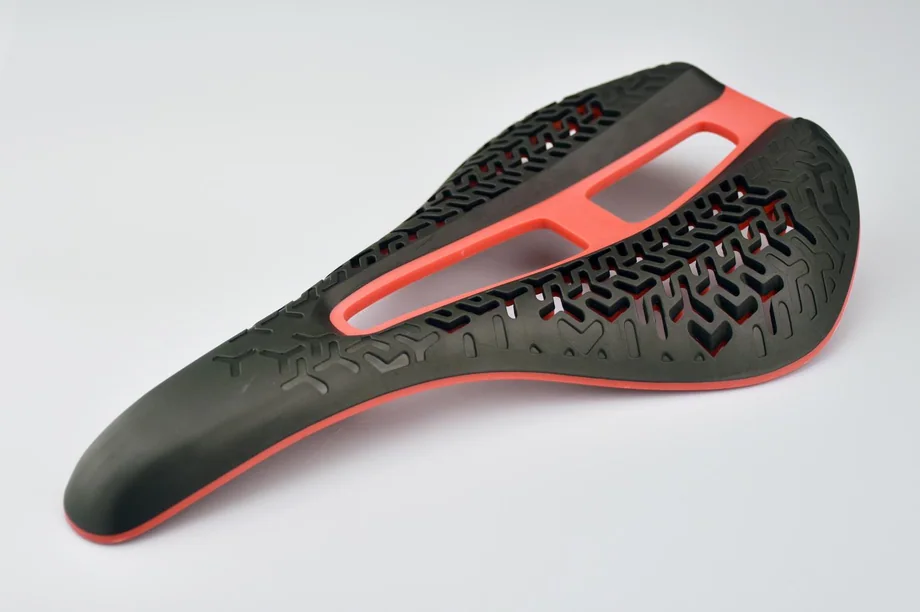
The two-shot bicycle-seat case is a useful illustration of a component whose two materials serve an integrated design. It should not be used to promise the same tooling economics, bond performance or production timing for a different grip. The relevant transferable idea is to resolve the two regions as one component before committing the manufacturing route.
Compare TPE grip trials with a controlled handling task
Agree what the sample review is meant to decide. An appearance sample may settle color and boundary position. A handling sample may settle texture and geometry. An assembly sample may reveal whether an overmold blocks a fastening or locating feature. Treating all three as one informal approval makes later decisions difficult to interpret.
- For a gloved controller, compare the same handling movement with the same glove condition.
- For a cleaned grip, identify the cleaning sequence before evaluating the exposed samples.
- For a loaded handle, describe the direction in which the user pulls, twists or presses.
- For an enclosure interface, check the rigid mounting features after the agreed molding sequence.
These activities need customer-defined acceptance where performance is involved. We can review molding feasibility and agreed dimensional inspection, but a material brochure or a pleasant first impression cannot establish the finished device’s service life. Keep observations specific enough to connect a proposed change to the problem it is intended to solve.
Surface references should survive the move from samples to production
If the grip texture is approved, retain a clear reference for it and identify the viewing and handling surfaces. JY Pretech’s article on injection-molded surface finishes provides background for communicating surface requirements. The final texture should be agreed for the selected material and tool, since a finish description alone cannot reproduce the feel of every compound.
Where a rigid shell is printed, coated or laser marked, separate those operations from the soft contact area in the drawing. Our secondary-operation range includes these processes, but compatibility and sequence require review. The grip should not be accepted while its final decoration or assembly step remains undefined.
A TPE handle redesign should preserve the spaces around the grip
Adding a soft layer changes the space occupied by the handle even when the rigid core stays the same. A controller that previously slid into a holder may no longer enter cleanly, and a grip that feels comfortable in isolation may press against an adjacent control. Give the team the holder, bracket or docking envelope when these interfaces matter. They belong in the same geometry review as the soft contact patch.
For a long handled component, distinguish the area used to carry the equipment from the area used to locate it in a fixture. The carrying region may benefit from a textured elastomer, while a locating surface may need a stable rigid reference. JY Pretech’s sectional overmolding approach allows those roles to be discussed separately instead of covering the entire substrate because the material is available.
A worn TPE grip should be described by the feature that changed
If the project begins with a failed or uncomfortable grip, show whether the concern is surface wear, an edge lifting, contamination, poor handling or interference with another part. These observations point to different technical questions. A smoother surface may call for a contact and exposure review, while a lifted termination brings the material pairing and retention geometry back into focus. Changing hardness alone may leave the relevant issue untouched.
Include the conditions in which the observation occurs and identify the returned part’s version where possible. The useful input is a traceable description of the grip problem, rather than a general request for a stronger TPE. Our team can then review the candidate family, local geometry and molding route against a specific requirement. The customer can use the next trial to decide whether that particular requirement has been addressed.
Keep the approved TPE grip construction identifiable at delivery
A receiving team should be able to distinguish alternative compounds, texture trials and released production. For a soft grip, identification matters because similar-looking parts may represent different handling decisions. Agree the drawing revision, material pairing and sample status that accompany the shipment, together with any requested material or inspection records.
Packaging deserves a component-specific discussion when soft edges can be held under load or cosmetic faces can rub during transport. Describe the surfaces that need protection and how the parts will enter assembly. The agreed arrangement should protect that particular geometry; there is no reason to assume one packing method suits a controller grip, a long handle and a two-shot seat component equally.
Bring the rigid model, the grip boundary and the intended handling task into the same review. That gives JY Pretech a useful basis for selecting a molding route and developing representative samples. The approval you want is a repeatable contact experience on an identified construction, with the joint, assembly features and final supplied condition understood together.