

 Get a Quote
How a Rubber Compression Molding Supplier Reviews Compound and Working Deflection
“Make it the same hardness” sounds precise until two rubber pads close very differently under the same cover. Their thickness, contact area, compound and installed gap can all matter. A rubber compression molding supplier needs that working context to review a useful component. For an industrial seal, protective profile or resilient pad, begin with the material requirement and the movement the part must accommodate.
JY Pretech offers compression molding for custom silicone and rubber components, supported by tooling and associated manufacturing resources. Its process description covers preparing a charge, forming it between mold halves and trimming the finished part as required. Share the component drawing and mating arrangement so the discussion addresses the actual supplied shape. Our manufacturing capabilities also provide alternatives where the application calls for another route.
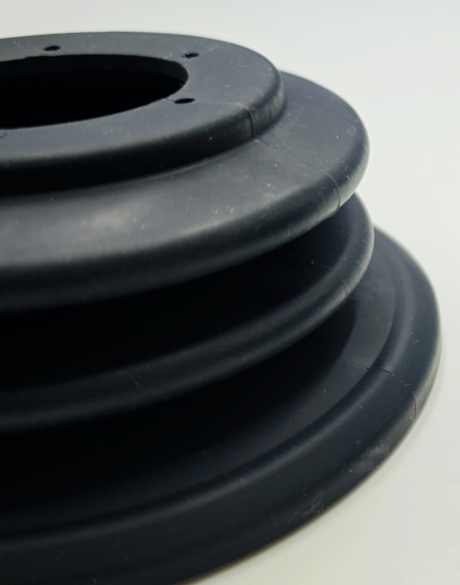
A rubber compression molding supplier needs more than a hardness number
Hardness describes one aspect of an elastomer. It does not identify the complete compound or determine every response of a finished geometry. A thin broad pad and a tall narrow feature can load differently even when their material hardness is similar. Specify the material and explain how the component is supported and compressed.
Shore A should remain connected to the actual compound
Shore A is a commonly used indentation-hardness scale for flexible materials. If the drawing specifies it, retain the required scale and the agreed checking conditions. Do not use an isolated number as a substitute for the compound designation. Different formulations can share a hardness value while differing in other properties relevant to the application.
For a purchasing team transferring an existing pad, ask the product owner for the approved material record. Identify any permitted alternatives and the evidence needed to accept them. JY Pretech can review the nominated material within the project scope, but an unnamed “equivalent rubber” should not become the manufacturing instruction by default.
Installed compression depends on the pad and the mating gap
Consider a cover that locates against rigid stops while compressing a rubber pad. The stops establish a different installation condition from a cover tightened without a defined final gap. Give the supplier that arrangement. A free-state thickness dimension alone cannot describe the way the pad works inside the equipment.
If the same pad is used across several cover versions, check the relevant mating dimensions for each. The molded part can remain unchanged while the assembly asks it to accommodate a different movement. Treat that as an application review rather than immediately changing rubber hardness to compensate for an undefined installation difference.
Contact area and restraint can change the pad’s closing behavior
A pad that can expand sideways is not constrained in the same way as a similar shape enclosed tightly in a recess. Explain the available space and the surfaces that support it. If a cover requires a particular closing action, define that requirement through the actual assembly rather than assume a hardness value will predict the complete force response.
| Assembly difference | Information to provide | Question to evaluate |
|---|---|---|
| Pad sits in an open space | Contact area and installed gap | Whether deformation remains compatible with closure |
| Pad sits inside a recess | Side clearance and locating geometry | Whether the component can occupy the intended compressed shape |
| A lip moves against another part | Movement direction and surrounding clearance | Whether the local geometry works through the required motion |
These comparisons are useful before a compound or tool change is approved. JY Pretech can review the custom geometry and manufacturing requirement, while the buyer establishes the equipment-level acceptance. Keeping those responsibilities connected allows a change to address the actual installation problem instead of creating a different part whose working condition is still undefined.
Review rubber compound exposure before changing the molded geometry
A sealing component may contact process fluid, cleaning chemicals, lubricants or the surrounding atmosphere. Describe the actual exposure, including relevant temperature and duration conditions. A material choice made only from a generic industry label can miss the environment that determines suitability. Keep the manufacturer’s forming task connected to a clear material requirement.
NBR, EPDM and silicone names identify families rather than complete specifications
These familiar elastomer names can help organize a technical discussion, but the specific compound remains important. Their mention here is general material-selection context, not a list of grades automatically available from JY Pretech. Provide the nominated designation or ask for a project-specific material review before approving the manufacturing basis.
Trelleborg’s static sealing material guidance treats fluid compatibility and physical properties as related selection factors. That principle is useful for a buyer reviewing rubber. The producer’s compounds, operating ranges and proprietary results should not be treated as JY Pretech product specifications.
A cleaning cycle is a different exposure from continuous immersion
A protective profile touched briefly by a cleaning solution can face a different condition from a seal continuously immersed in a process medium. Explain which situation applies. If several chemicals are used, identify them rather than summarize the requirement as “chemical resistant.” The intended exposure should guide material review and customer application testing.
For an equipment purchaser, a short application description can therefore be more valuable than a longer list of general properties. State where the component sits, which surfaces contact fluid and whether the part moves during use. This gives the supplier a coherent manufacturing brief without implying that a generic rubber family covers every environment.
Compression molding connects charge preparation with the finished profile
JY Pretech’s compression route begins with a defined material charge placed into the mold. Pressure forms the material against the cavity, with heat and curing considered according to the material system. The order should define the finished component and the required supplied condition; process settings need to be reviewed for that specific work.
Charge quantity and flash removal belong to the same component discussion
Excess material can appear at mold interfaces and require trimming. Identify which edges are functional and what finished condition they need. A sealing edge, an attachment flange and a clearance region can carry different requirements. The supplier should not have to infer those differences from a single general note about appearance.
Our silicone sealing-face guide examines that edge question for a pad. A rubber profile with an attachment flange introduces another relationship: the trimmed boundary must remain compatible with how the part is located or retained. Define that function before accepting a general trimming description.
A bellows profile should be evaluated through its intended movement
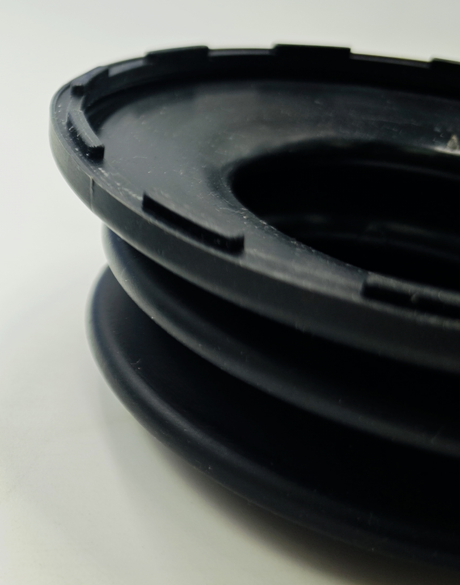
The compression molding examples include flexible formed profiles. For a protective bellows-type component, identify the attached positions, surrounding clearance and expected movement. A relaxed photograph does not describe the full working envelope. The buyer should provide the geometry and application conditions needed for an appropriate project review.
A service technician may compress or extend the profile during installation even if normal equipment movement is limited. Include that handling condition where relevant. It can expose a thin section or attachment region to a different demand from the one suggested by the free-state drawing. The manufacturing and application acceptance should remain distinct but connected.

Define rubber dimensions in a condition that can be repeated
Flexible components can change shape under handling and measurement. Agree how the part is supported when its thickness, profile or opening is checked. A result taken while pulling the component into place can be difficult to compare with a relaxed-state requirement. The measurement condition belongs beside the dimension when it affects interpretation.
A broad pad should not be forced flat without an agreed reason
If the acceptance requirement concerns the relaxed part, explain how it is presented for checking. If the component is intentionally assessed within a defined assembly constraint, identify that arrangement instead. Neither condition should be assumed from a photograph. The buyer and supplier need to compare the same object under understandable conditions.
JY Pretech’s quality and project review information provides a route for discussing inspection and records. For rubber, select checks appropriate to the material and feature. The availability of equipment for rigid components does not mean that the same method answers every question about a deformable pad.
Rubber recovery and compression set need an application-specific assessment
Recovery after deformation and permanent change after sustained compression can matter to service performance. Define the relevant requirement and test conditions with the product owner. Do not infer long-term recovery from a finger-pressure demonstration or an initial closure trial. Those observations can be useful, but they answer narrower questions.
The DuPont elastomer troubleshooting resource discusses compression set and chemical compatibility as separate diagnostic issues. Its general distinction helps prevent a buyer from treating every sealing problem as a hardness problem. It does not establish a tested result for a JY Pretech component.
When a pad closes differently: compare the material identity, actual thickness, mating gap and checking condition before changing the tool. An unexplained hardness adjustment can conceal the cause instead of defining the component properly.
Compare compression molding with the other component routes available
JY Pretech also offers LSR injection molding. If silicone is the approved material, the geometry and production program can justify reviewing that route. Compression and LSR injection should be compared as complete manufacturing proposals rather than assumed to supply identical materials and operations on identical terms.
A material change can reopen more than the process selection
Changing a rubber component to silicone, or changing the selected formulation within a family, can affect the evidence needed for the application. Identify the reason for the proposal and the properties that must remain acceptable. The ability to mold a shape does not by itself prove an interchangeable replacement in the customer’s equipment.
For a component combining a flexible item with rigid plastic hardware, review both interfaces. JY Pretech’s wider tooling and molding range allows related manufacturing questions to be discussed together. Keep each part’s material and acceptance definition identifiable so the convenience of a coordinated supply route does not obscure the individual requirements.
Custom tooling should follow the released rubber component
Our tooling and mold component service provides the broader construction context. For a compression order, the tool proposal should refer to the accepted rubber geometry and the required molding route. State whether the order buys finished components, tooling or both, because those objects need different delivery and approval records.
A development trial may be intended to establish fit before the compound is finally approved. Record that limited purpose. A later material change should be reviewed against the final component and application requirements rather than treated as a purchasing substitution with no engineering consequence.
Receive rubber components with their accepted material and shape intact
Agree handling and packing around the actual profile. A flat pad, thin lip and formed bellows can need different support or separation. The relevant question is whether the accepted geometry and required surface condition will remain suitable for the next operation. Confirm the method for the order rather than infer a universal package from the process name.
Keep material and revision identification connected to the delivered parts. Similar black components can be difficult to distinguish visually, and appearance does not verify compound identity. If trial and released parts are both present in a project, their status should remain clear when they reach a receiving team that did not participate in the development work.
JY Pretech’s company profile explains its custom manufacturing model and coordinated resources. For the rubber order, confirm the actual quantity, material basis, included finishing, inspection and delivery arrangement. A broad service capability becomes useful when those items describe the same supplied component.
Return to the two pads with the same hardness request. Give JY Pretech the compound requirement, relaxed geometry, installed gap and relevant exposure. That definition lets the supplier review the compression-molded part around its working deflection, while the product owner evaluates the performance required in the real assembly.